
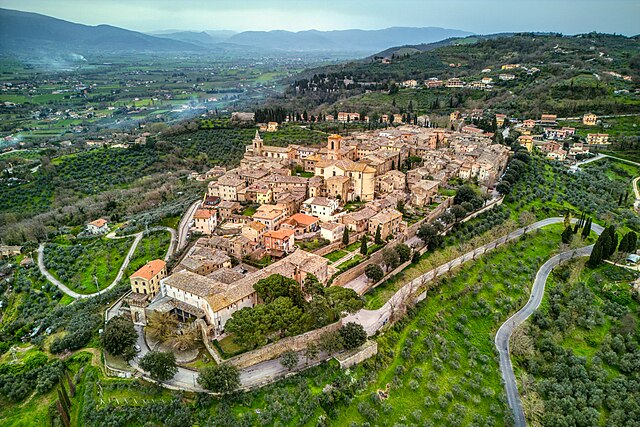
Bettona is 365 meters above sea level, perched in a panoramic position on a hill that is part of the northern foothills of the Martani Mountains. From here there is a spectacular view, almost like looking out from a terrace over the Umbrian Valley, with its surrounding towns and distant mountains framing it in a semicircle.
The territory of Bettona is bounded to the north by Bastia, to the east by Assisi and Cannara, to the south by Deruta and Collazzone, and to the west by Torgiano. The flat area, which averages 180 meters above sea level, is formed by alluvial deposits along the courses of the Chiascio and Topino rivers. This location gives Bettona a very pleasant climate, with an average annual temperature around 13°C, lows reaching about 1°C in January and highs reaching 24°C in July. The wettest months are October and November, and the main winds are Ponentino and Tramontana.
An oval-leafed plant, Betonica officinalis, appears in the city’s coat of arms, which according to a popular etymology gave the city its very name. This plant, known for its many healing properties and widely distributed in Italy, has also inspired two popular sayings: “having more virtues than betonya” and “known more than betonya.”
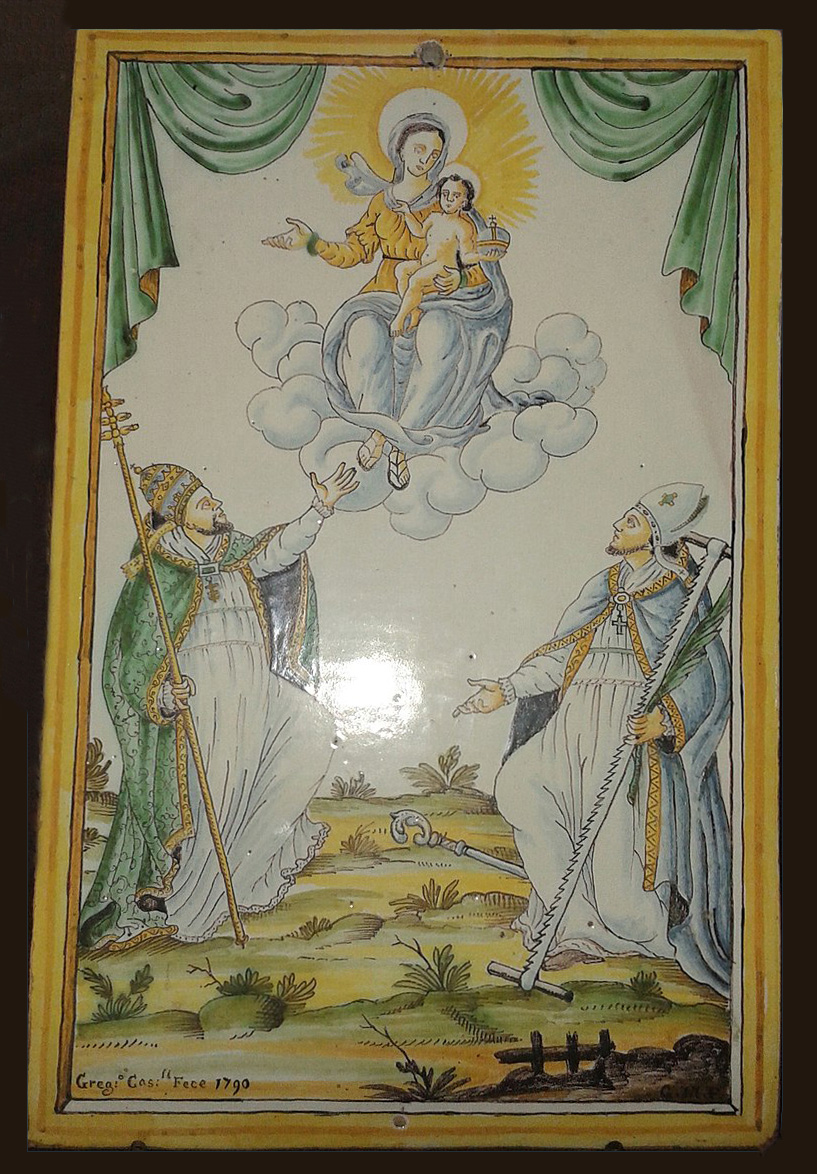
The patron saint of the city is St. Crispolto, whose memory falls on May 12. According to the Acta Sanctorum, Chrysoprotus was one of Christ’s earliest followers and is usually depicted with bishop’s attributes, such as the miter and crozier, and with the symbol of his martyrdom, a saw. Tradition has it that, sent to Italy by the apostle Peter, Crispolto was arrested under the emperor Maximian, tortured, thrown into a furnace, scourged and finally sawed to death. At the site of his martyrdom, near the Abbey, a basilica would be built in his honor.
However, there are some chronological inconsistencies in the story of Chrysopolytus, since, to have lived during the time of St. Peter and to have been martyred under Maximian in the third century, he would have had to have reached almost two hundred years of life. For this reason, as early as 1628, historian Jacobilli suggested the existence of two distinct Crispoltos: one coming from the East and the other originating precisely in Bettona.
The dubious historicity of the saint and the presence as early as the 11th century of a church dedicated to him at the site of his alleged martyrdom highlight how the cult of Crispolto took on legendary characteristics, aimed at strengthening his prestige and spreading local devotion. This represents one of many examples of how a martyr figure, in this case bishop of the city itself, becomes a symbol of municipal identity and autonomy. In fact, to further emphasize this identity bond, in 1265 the body of St. Crispolto was taken from the Badia and moved inside the city walls; for the same reason, when Perugia defeated Bettona in 1352, it deprived the city of the saint’s precious relics.